How to store old family photos so they last
TL;DR
Old photos last longest in a cool, dry, dark place, stored flat or upright in boxes and sleeves made for photos. Most damage comes from four things: damp, heat, light and the wrong albums. If you avoid those, prints that are already eighty years old can easily last another eighty.
Old photos last longest in a cool, dry, dark place, stored flat or upright in boxes and sleeves made for photos. Most damage comes from four things: damp, heat, light and the wrong albums. If you avoid those, prints that are already eighty years old can easily last another eighty.
Where to keep them
Choose a room where you would be comfortable yourself. That rules out:
- Basements, which are often damp. Damp causes mould and makes prints stick together.
- Attics and lofts, which get very hot in summer and cold in winter. The changes crack the surface of photos over time.
- Garages and sheds, for both reasons.
A shelf in a wardrobe or a cupboard in a bedroom is usually ideal. Keep boxes off the floor in case of a leak.
Keep them out of the light
Daylight fades photos, especially colour prints from the 1970s and 1980s, which often turn orange or pink. If you want an old photo on the wall, hang a copy and keep the original in a drawer.
Use the right boxes and sleeves
Look for boxes and sleeves labelled "acid-free" or "archival". Ordinary cardboard and some plastics slowly release chemicals that yellow and weaken photos.
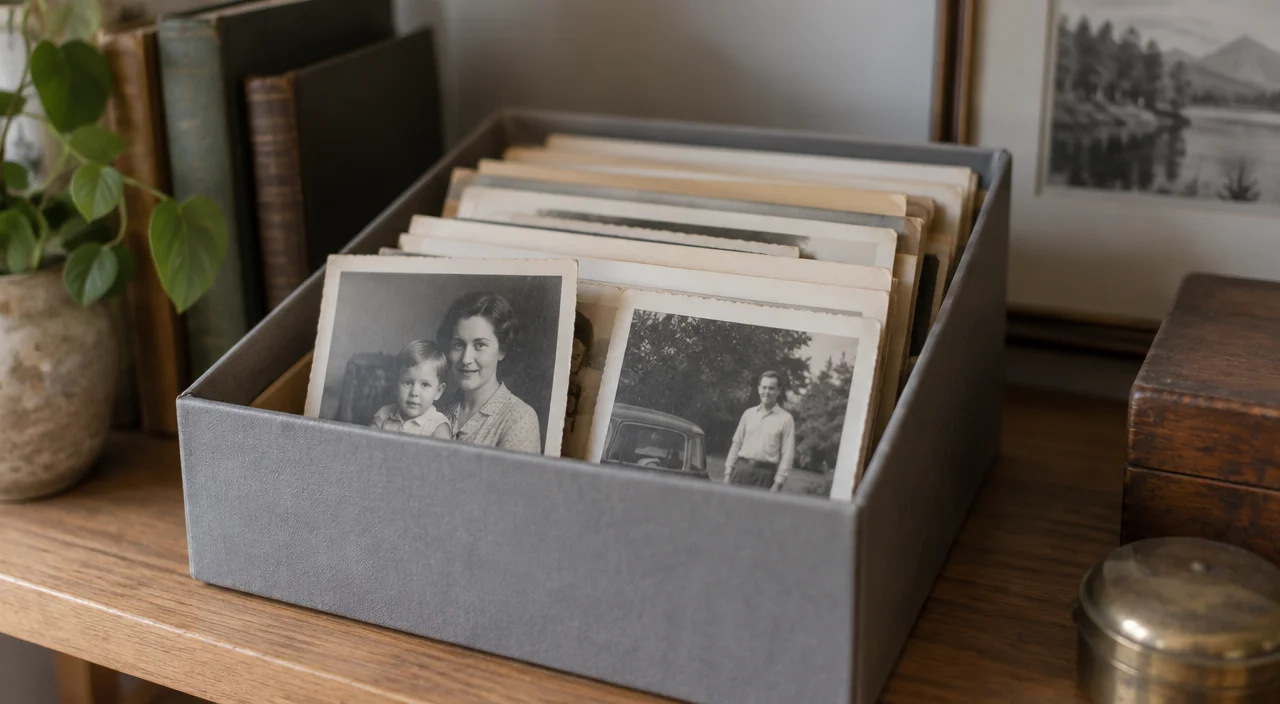
Store prints of a similar size together, either flat or standing upright, so they don't bend. Don't pack a box so tight that you have to force prints in and out.
Get them out of sticky albums, carefully
The "magnetic" albums popular from the 1960s to the 1980s, with a sticky page and a plastic cover, are hard on photos. The glue yellows and grips the back of the print.
If a photo comes away easily, move it to a better album or sleeve. If it's stuck, don't pull. You can slide a length of dental floss behind a corner and gently work it under the print. If it still resists, leave it there and make a copy instead. A torn original is worse than one stuck to a page.
Handle them by the edges
Fingerprints leave oil that can damage a print years later. Hold photos by their edges, with clean, dry hands. For something very fragile, cotton gloves help.
Don't use sticky tape, rubber bands or paper clips on photos. All three leave marks.
Write on the back, gently
Names and dates on the back are what make a photo meaningful to the next generation. Use a soft pencil and write lightly near the edge. Ballpoint pens press through and show on the front, and some markers bleed over time.
Make copies
The safest photo is one that exists in more than one place. Make digital copies of the ones that matter most, then keep those files in two places, for example on your computer and in an online storage account.
Our guide on how to scan old photos with your phone shows how to get good copies without a scanner. And if some prints are already faded or torn, you can restore them online from those copies, while the originals stay safe in their box.